

📋 In this article:
You have noticed for a few months that your arch seems to be gradually flattening. Your shoes wear out strangely on the inner edge. After an hour-long walk, the inside of your ankle hurts — not a sharp momentum, but a dull ache that accompanies you for the rest of the day. You wonder if this is normal. You mostly wonder if it means surgery.
The good news is that this is statistically unlikely. According to a basic clinical study, 83% of adults with acquired flat foot regain normal function and relieve their pain without ever going under the knife. Four out of five patients.
What makes all the difference? Early diagnosis, the right orthotics — not just any orthotics — and a structured exercise program. What you’re reading right now is your roadmap.
What is adult acquired flat foot?
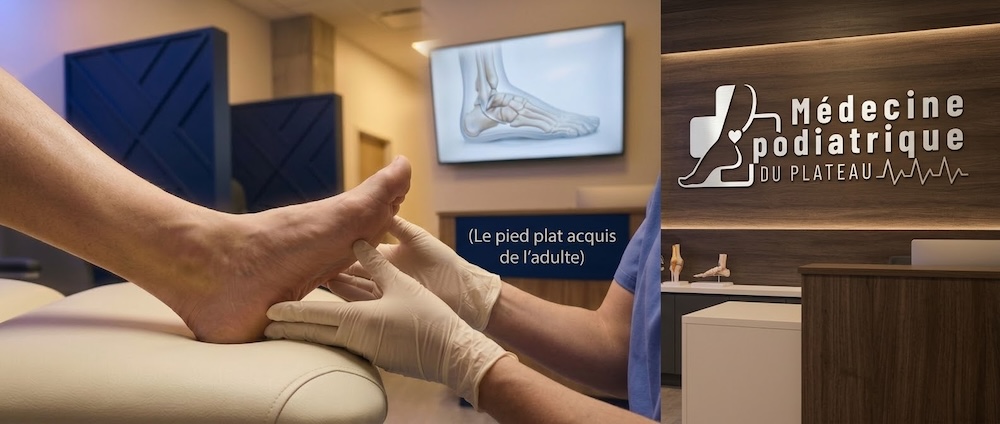
Let’s start by demystifying the diagnosis. The adult flat foot now has a more precise international name: PCFD, for Progressive Collapsing Foot Deformity. This technical acronym actually hides a very human process: the gradual loss of the arch of the foot in adults and the cascade of biomechanical problems that results from it.
Your foot is not a static structure. It is a masterpiece of living engineering. At the heart of this architecture is a discreet but crucial tendon: the posterior tibial tendon. This tendon is a major stabilizer. It holds the arch of your foot, absorbs shock when walking, and allows plantarflexion — the action of pointing the foot downwards.
However, over time — irritation, strain injuries, wear and tear related to age or conditions such as obesity, diabetes or hypertension — this tendon can degenerate. It loses its elasticity. The arch of the foot gradually collapses. And unlike the congenital flat foot (present since childhood), this acquired form progresses. It worsens without intervention.
Some risk factors accumulate after the age of 40. Being overweight puts more strain on this fragile tendon. Diabetes affects the quality of tissues. A history of ankle injury multiplies the risks. That’s why so many adults between the ages of 45 and 65 suddenly develop this condition — not overnight, but gradually, almost imperceptibly.
So the question you should be asking yourself today is not “Will I need surgery?”, but rather “What stage am I at and how can I act now to prevent progression?” A professional biomechanical assessment answers precisely this question.
💡 To remember
Acquired flat foot is different from congenital flat foot: it progresses over time. Without intervention, the deformity advances to irreversible stages. Acting early — in stages I and II — produces the best results. Results vary according to the condition of each person.
The Signs That Don’t Lie
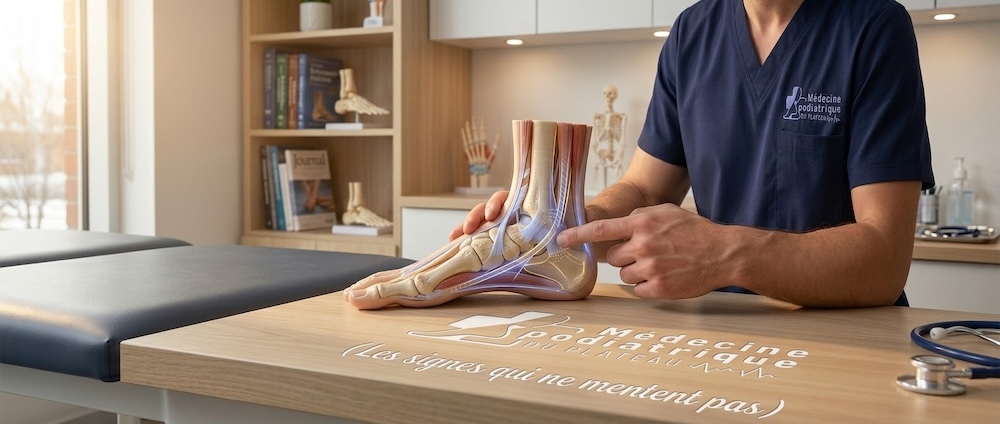
If the acquired flat foot progresses silently, it leaves detectable clues. Here are the five red flags you need to be aware of.
1. Pain on the inside of the ankle after walking. It is not sudden acuity, but persistent fatigue or discomfort along the posterior tibial tendon, usually after 30 to 60 minutes of walking. Your heel feels tired, as if it has become heavier.
2. The arch of your foot visibly flattens out. When comparing an old photo of your standing foot to a current one, you notice that the space under your arch looks less arched. The vault is no longer where it used to be.
3. The sign of “too many toes”. Look at your foot in a mirror, from the back. If an outside observer sees more toes than usual when looking at your foot from behind, your foot is spilling — it is tilting inward. This is one of the most telling signs of the PCFD.
4. Uneven wear on your shoes. The inside of the heel visibly wears out faster than the rest. When you turn your shoe inside out, you can clearly see that the inner side is eroded.
5. Inability to stand on tiptoe. Try this: Stand up, raise one leg, and lift yourself on the tip of the other foot. Difficult? Impossible? It is a classic clinical test that betrays a weakness of the posterior tibial tendon.
🎯 Practical advice
If you recognize two or more of these five signs, now is the time to act. The earlier the intervention, the more convincing the results. A consultation with a podiatrist for a biomechanical evaluation will give you the certainty you are looking for.

The study that changes everything: 83% success rate without surgery
Statistics are nice, but they are of little value if they do not have a solid scientific basis. Here’s the real story behind that 83% figure.
In 2006, a team of researchers published a clinical trial involving 47 patients with acquired flat feet (stages I and II on a severity scale). These patients were not operated on. Instead, they were offered a very structured protocol:
- An articulated ankle-foot orthosis tailor-made for each patient
- High repetition exercises specifically targeting plantarflexion
- A home exercise program that includes intense calf stretches
- Clinical follow-up, with a median of 10 visits spread over 4 months
The results? Remarkable. 39 of 47 patients (83%) tested positive. Their pain had decreased significantly. Their function had improved. 89% were satisfied with the treatment. Only 11% had to undergo surgery — and usually because they had waited too long, allowing the deformity to progress to advanced stages.
Since then, the data has been accumulating. A recent meta-analysis confirms these findings: conservative interventions produce measurable and lasting improvements—on average 3 to 5 degrees of reduction in foot eversion and 6 to 9 degrees of improvement in plantar flexion capacity. Translated into concrete language: your foot regains its natural stability. Your gait improves. Your pain is receding.
What makes these figures particularly exciting is that they only concern the early stages of the PCFD. In other words, the sooner you act, the higher your chances of success. The cases that failed—the 11 percent who needed surgery—had generally ignored the initial symptoms and waited years before seeking surgery.
It’s a powerful call to action: if you recognize the signs, don’t procrastinate. An evaluation today can save you from surgery tomorrow.

Custom Orthotics vs Pharmacy Orthotics: Why It’s Not the Same
Here, we have to be honest with you: there is a considerable difference between an orthosis bought at the pharmacy counter and an orthosis prescribed and custom-made by a podiatrist.
Pharmacy orthotics are not useless. They offer passive comfort. They can help with minor fatigue-related pains. But they work according to a generic template — small, medium, large size. They assume that all the flat feet acquired are identical. However, they are not.
Your foot has a unique geometry. Your eversion position is different from your neighbor’s. The stage of your tendon degeneration varies. Your biomechanical correction needs are specific to you.
A custom-made orthosis begins with a thorough biomechanical evaluation. The podiatrist examines your gait, measures the angle of your foot, tests the strength of your posterior tibial tendon. Next, a cast of your foot is taken — not a generic impression, but a 3D or plaster cast that captures the exact geometry of your arch.
From this molding, the orthosis is custom-made. It incorporates active biomechanical correction : it doesn’t just support your collapsed arch, it corrects it gradually. It repositions your foot in a way that relieves the tired posterior tibial tendon and restores your natural alignment.
| Appearance | Pharmacy | Custom orthosis (podiatrist) |
|---|---|---|
| Design | Generic Molding (S/M/L) | Molded to the geometry of your foot |
| Correction | Passive | Active biomechanical correction |
| Adaptation | Standard | Adjusted to the stages of the PCFD |
| Follow-up | None | Periodic adjustments as needed |
| Results | Temporary | Validated treatment (83% according to studies) |
After the tailoring, you will return to the clinic a few times for adjustments. One foot changes; An orthosis must adapt. This iterative cycle of prescription, manufacturing, wearing and fitting — that’s what generic orthotics lack. This is also what explains the success rate of 83%. Results vary according to the condition of each person.

The exercise program that makes the difference
Orthotics alone are not enough. In the study protocol that produced this 83% rate, the exercises played an equal role to that of the orthosis. Here is the simplified program, adapted for daily practice. Allow 15 minutes a day, ideally in the morning or before a long walk.
1. Unipodal point mounting
This exercise directly targets the posterior tibial tendon and strengthens its plantarflexion ability.
Stand near a counter or ramp. Lift one leg — bend your knee slightly. On the other foot, lift yourself as high as you can on your toes. Hold for 2 to 3 seconds. Slowly come back down. Repeat 10 times. Change your footing. Three sets on each side, at least 3 times a week.
If it’s too difficult at first, hold on to both hands and gradually increase.
2. Calf stretch
A taut calf limits plantarflexion. Flexibility is therefore essential.
Facing a wall, place one foot forward (knee slightly bent), the other leg extended behind you. Gently press your back heel to the floor and move your hips forward toward the wall. You should feel a pleasant stretch in the calf. Hold for 30 seconds. Repeat 3 times on each side, daily.
3. Resisted inversion
This exercise stabilizes the lateral muscles of the foot and counteracts the tendency to eversion.
Sitting, one leg extended. Wrap a resistance band around the sole of your foot. Pull your toes toward your shin, then slowly turn your foot inward against the resistance of the elastic. 15 repetitions, 3 sets, three times a week.
4. Pointe Walking
Simple functional strengthening: walk on your tiptoes for 30 seconds. Rest. Repeat 3 times. Once a day, that’s all it takes.
⚠️ Important
These exercises complement your custom orthotic — they are not a substitute for it. The orthosis creates favorable biomechanical conditions; Exercises strengthen weakened muscle structures. Together, they are making change. Consult your podiatrist before starting if you already have noticeable pain. Results vary according to the condition of each person.
Frequently asked questions about acquired flat foot
Can the acquired flat foot be completely corrected?
Yes, especially in the early stages (I and II). The sooner you intervene, the more complete the possible correction. In advanced stages (III and IV), the deformity has crystallized and complete correction may be more difficult. That’s why a rapid biomechanical assessment — at the earliest signs — is critical. Studies show that patients who act within 6 to 12 months of the onset of symptoms have the best results. Results vary according to the condition of each person.
How long does conservative treatment last?
Generally, 3 to 6 months to see a significant improvement. The median duration observed in the studies is about 4 months of active treatment — orthosis, exercises and clinical follow-up — to achieve significant functional recovery. After that, you will continue to wear your custom-made orthotic, probably in the long term, but the intensive work is over. You maintain results rather than build new ones.
Are custom-made orthotics covered by insurance?
It depends on your private insurance plan. Many plans partially or fully cover orthotics prescribed by a podiatrist with a degree of doctor of podiatric medicine. Check directly with your insurer before starting treatment. The clinic can provide you with a prescription letter and detailed documentation to help with the claims process. If you have any questions, call 819-800-1212.
When does surgery become necessary?
When conservative treatment has not produced the expected results — which concerns about 11% of cases according to the studies — or when the deformity has progressed to stages III and IV. But let’s remember: the success rate of conservative treatment is 83%. The odds are overwhelmingly in your favor, as long as you act early. Intermittent pain in the inner ankle, an arch that gradually flattens — these are not trifles. These are signals that the time to act is now.
How do I know if I need custom-made orthotics?
Only a professional biomechanical evaluation can answer this question with certainty. Pharmacy orthotics may seem less expensive at first glance, but they often produce disappointing results — temporary relief without any real treatment. An evaluation by a podiatrist will give you a clear diagnosis of your stage of PCFD, an objective measure of your functional deficit and a specific recommendation. Do not self-diagnose with pharmacy purchases. It’s your foot — your mobility, your quality of life — that depends on it. At the Médecine podiatrique du Plateau, Drs. Émile Carrier, Sandra Gendron and Stephen Davis, podiatrists, perform complete biomechanical evaluations. Make an appointment at 819-800-1212.
You hold your future in your hands
Adult flatfoot is indeed a progressive condition. But the science speaks for itself: 83% of patients who act quickly and follow a structured protocol regain normal function without ever going to the operating room. Four out of five people.
What is needed are three aligned elements: early and accurate diagnosis, the right orthotics — tailor-made, tailored to your body type and stage — and a commitment to daily exercise. It’s neither fast nor spectacular. It’s methodical. It’s gradual. That’s right.
You’ve noticed that your foot is changing. You felt that pain in your inner ankle. You’ve seen the uneven wear on your shoes. It’s your body talking to you. Listen to him.
The next step is simple: make an appointment for a complete biomechanical evaluation. Not an ordinary visit, but a structured assessment that measures your deficit, classifies your PCFD stage and offers you a clear action plan. It’s the first step toward recovery — and according to the data, probably the only one standing between you and avoiding surgery.
Your feet carry you. We take care of it.
Podiatric Medicine of the Plateau
Drs. Émile Carrier, Sandra Gendron and Stephen Davis, podiatrists — AGORA, Gatineau
819 800-1212 | podiatreplateau.com
