

📋 In this article:
- → Hyaluronic acid is not just for the joints
- → The true timeline of results week after week
- → Why hyaluronic acid rather than cortisone?
- → Ultrasound guidance: precision that makes the difference
- → Who is hyaluronic acid recommended for?
- → What you need to know before you get started
- → Our Approach to Médecine Podiatrique du Plateau
- → Frequently Asked Questions
Direct answer: Hyaluronic acid injections for the tendons and fascia of the foot show a significant reduction in pain from the first 6 weeks, with results gradually improving up to 12 weeks and beyond. Unlike cortisone, which acts quickly but temporarily, hyaluronic acid works deep down to promote the regeneration of injured tissue — and that’s the difference.

Direct answer: Hyaluronic acid injections for the tendons and fascia of the foot show a significant reduction in pain from the first 6 weeks, with results gradually improving up to 12 weeks and beyond. Unlike cortisone, which acts quickly but temporarily, hyaluronic acid works deep to promote the regeneration of injured tissue — and that’s the difference.
Why this topic really cares about you
You’ve probably heard of hyaluronic acid before. Maybe it has even been recommended to you for your chronic Achilles tendonitis or plantar fasciitis that refuses to heal despite your best efforts. And the burning question is: does it really work, and above all, how long before you feel a difference?
This is a legitimate question. Because after months of limping, avoiding stairs, giving up Sunday walks or yoga class, you want concrete answers — not vague promises.
In our practice in Gatineau, we regularly see patients who have tried everything — rest, ice, anti-inflammatories, physiotherapy — and are wondering if hyaluronic acid could finally be the solution to their persistent pain.
Here’s what the research tells us, and what we’re seeing in the clinic.
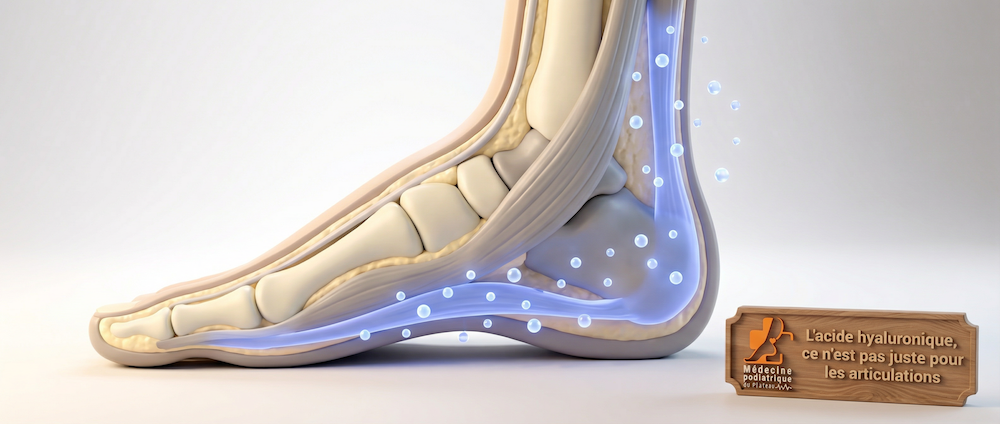
Hyaluronic acid is not just for the joints
Hyaluronic acid is particularly effective for soft tissues — tendons and fascia in the foot — and not just worn out joints. This substance that your body naturally produces can be injected precisely where your structures are damaged.
First thing to clarify: when we think of hyaluronic acid, we often think of osteoarthritis knees. It is true that this substance has been used for a long time to lubricate worn joints. But what many don’t know is that hyaluronic acid is particularly effective for soft tissues — and that’s great news for your feet.
What exactly are we talking about? Tendons, such as the Achilles tendon, which makes you suffer with every step. Plantar fascia, that strip of fabric under your foot that makes you feel like you’re walking on nails in the morning.
A meta-analysis published in Sports Health analyzed 19 studies involving more than 1,600 patients with soft tissue injuries. The results? Hyaluronic acid has been shown to be more effective than placebos, cortisone, PRP, and even physical therapy alone in reducing pain.
And the best part: the effects aren’t just temporary. They persist over time.
“Hyaluronic acid doesn’t just mask pain — it creates the conditions for your tissues to regenerate.”

The True Results Timeline: What to Expect Week After Week
The first improvements appear between weeks 1 and 6. The results are confirmed between 6 and 12 weeks. Beyond 12 weeks, studies show not only a maintenance of results, but often a continuous improvement — where cortisone fades.
Let’s talk concretely. Here’s what science and clinical experience show:
Weeks 1 to 6: the first signs of improvement
Don’t expect an instant miracle. Hyaluronic acid is not cortisone — it doesn’t mask pain in a few days. Its action is more subtle, more progressive, but also more lasting.
During this first period, the substance begins to integrate into the tissues. It attracts water, rehydrates damaged structures, and creates an environment conducive to healing. Most patients notice a gradual decrease in their pain, often described as a shift from “unbearable” to “manageable.”
Weeks 6 to 12: the improvement is confirmed
It’s usually during this time that patients say, “I’m really starting to feel a difference.” The pain when waking up subsides. Activities that were impossible become possible. You may start walking longer again, climbing stairs without wincing.
Studies show a significant reduction in pain on the visual analogue scale during this window. And unlike cortisone, whose effects can fade over time, the improvement is maintained.
Beyond 12 weeks: results that last
This is where hyaluronic acid really stands out. In the medium term, after three months, studies show not only a maintenance of results, but often continuous improvement. The tissues have had time to regenerate. Chronic inflammation has decreased. Your body has done its job of repairing, helped by this substance that it produces naturally.
💡 To remember
Weeks 1-6: first gradual improvements. Weeks 6-12: significant results. Beyond 12 weeks: lasting effects and continuous improvement. Patience is key—hyaluronic acid works deeply, not on the surface.
Why hyaluronic acid rather than cortisone?
Cortisone puts out the fire quickly, but does not rebuild the house. Repeated injections can weaken the tissues in the long term. Hyaluronic acid works differently: it creates the conditions for your tendons and fascia to truly regenerate.
This is the question our patients regularly ask us. And it deserves a nuanced answer.
Cortisone, let’s be clear, has its place in our therapeutic arsenal. It is remarkably effective in quickly calming acute inflammation. If you are suffering martyrdom and need immediate relief to be able to function, it is a relevant option.
But here’s the thing: cortisone has no regenerative or repairing power. She puts out the fire, but she doesn’t rebuild the house. Worse still, repeated injections can weaken tissue in the long term, increasing the risk of tendon rupture.
Hyaluronic acid works differently. It doesn’t just mask pain — it creates the conditions for your tissues to regenerate. It acts as a natural lubricant, gradually reduces inflammation, and promotes the healing of damaged fibers.
That’s why, for chronic problems like Achilles tendonitis that has been dragging on for months or recalcitrant plantar fasciitis, we can consider this approach.
“You have to treat the right thing for you to have the best results.”
— Dr. Émile Carrier, podiatrist

Ultrasound guidance: precision that makes the difference
We use ultrasound guidance for all of our hyaluronic acid injections. In real time, we visualize the tendon or fascia and deposit the substance precisely where it needs to work. This accuracy is not a luxury — it’s what optimizes your results.
A hyaluronic acid injection cannot be improvised. The substance must be deposited in exactly the right place to be effective. Too far from the damaged tendon and you will not get the results you hoped for.
That’s why we systematically use ultrasound guidance for our injections. In real time, we visualize the tendon, fascia, ligament or structure concerned. We see exactly where the needle is. And we deposit the hyaluronic acid precisely where it needs to work.
This accuracy is not a luxury — it’s a necessity to optimize results. Studies also seem to indicate an advantage of image-guided injections over injections by anatomical landmarks alone.
🎯 Pro Tip
During your consultation, do not hesitate to ask if the injection will be guided by ultrasound. This accuracy can make a real difference to the quality and durability of results.
Who is hyaluronic acid recommended for?
Hyaluronic acid is particularly suitable for chronic tendinopathy, recalcitrant plantar fasciitis, ligament sprains and patients who want to avoid cortisone or have already received several injections.
Hyaluronic acid is not the solution to all foot problems. But for some situations, it is a particularly interesting option:
Chronic tendinopathy — When your Achilles tendonitis or posterior tibialis tendonitis refuses to heal despite rest and exercise, hyaluronic acid can jump-start the healing process.
Recalcitrant plantar fasciitis — This pain under the heel that has been causing you pain for more than six months and is resistant to conventional treatments may respond favorably to injections.
Ligament sprains — These injuries that can occur to the ankle, for example, can take a long time to heal. Early periligamentous infiltration of hyaluronic acid can significantly accelerate healing.
Patients who want to avoid cortisone — Either because they’ve already had multiple injections or because they prefer a more regenerative approach.

What you need to know before you get started
The injection is generally well tolerated — discomfort comparable to a blood test. Slight swelling may occur within 24 to 48 hours. Most private insurances, the CNESST and the SAAQ reimburse hyaluronic acid.
The injection itself is generally well tolerated. Most patients describe minimal discomfort, comparable to a blood test. Slight swelling or tenderness at the injection site may occur within 24 to 48 hours, but these side effects are rare and resolve quickly.
It is recommended to limit strenuous activities during the first few days after the injection. Applying ice can help if you experience discomfort. And above all, you have to be patient: the optimal results appear gradually over several weeks.
The cost of hyaluronic acid varies depending on the product used and the amount needed. The good news? Most private insurances, the CNESST and the SAAQ reimburse this product. We will provide you with all the necessary documentation for your claims.
💡 To remember
For tendons and fascia, two injections are usually required — unlike osteoarthritis which may require annual injections. A personalized protocol is established during your evaluation.

Our Approach at Médecine podiatrique du Plateau
In Gatineau, hyaluronic acid injections are always part of a global approach: evaluation of the causes, personalized plan, custom orthotics if necessary and follow-up. The goal: that you can resume your activities without pain.
Here in Gatineau, hyaluronic acid injections are always part of a global approach. We don’t just poke and hope it works.
The first step is a comprehensive assessment. We want to understand why your tendon or fascia was injured in the first place. Is it a biomechanical problem? An overload linked to a change of activity? Unsuitable shoes? Without correcting the cause, the problem may return.
Then, we develop a personalized treatment plan that may include, depending on your situation:
- Hyaluronic acid injection guided by ultrasound
- Custom-made foot orthotics to correct biomechanical imbalances
- A strengthening and stretching exercise program
- Complementary therapies such as radial shock waves or therapeutic laser
Drs. Émile Carrier, Sandra Gendron and Stephen Davis, podiatrists, are there to accompany you every step of the way. Our goal? That you can get back to your activities painlessly — whether it’s walking with your grandchildren, running your weekly 5K, or just getting up in the morning without worrying about that first step.
📍 20, allée de Hambourg, AGORA, Gatineau | 819-800-1212
Results vary according to the condition of each person. A care plan is drawn up after evaluation.
📖 A short glossary to better understand
- Viscosupplementation
- Injection of a viscous substance (such as hyaluronic acid) to lubricate a joint or soft tissue and reduce pain.
- Plantar fascia
- A band of fibrous tissue that extends under the foot from the heel to the toes. Its inflammation is called plantar fasciitis.
- Chronic tendinopathy
- Degeneration of a tendon caused by repeated overload or incomplete healing. More difficult to treat than acute tendonitis.
- PRP (Platelet-Rich Plasma)
- A treatment that uses the patient’s own concentrated blood cells to stimulate tissue healing.
Frequently Asked Questions
Does hyaluronic acid injection hurt?
Most patients describe minimal discomfort, comparable to a blood test. The ultrasound guidance allows for precise and fast injection. Slight swelling may occur in the following hours, but usually resolves within 24 to 48 hours. Results vary according to the condition of each person.
How many injections are needed to get results?
For tendons, fascia and ligaments, two injections are usually required, unlike osteoarthritis which may require annual injections. Your podiatrist at Médecine podiatrique du Plateau will determine the optimal protocol for your situation during the initial evaluation.
Can I walk normally after the injection?
Yes, but we recommend limiting strenuous activities for 48 hours. Normal walking is possible immediately after the operation. Avoid long standing and sports activities during the first few days.
What is the difference between hyaluronic acid and PRP?
PRP (platelet-rich plasma) uses your own blood cells to stimulate healing, but can take several months to be effective. Hyaluronic acid works faster and studies show comparable or better effectiveness for soft tissues, as well as a lower cost.
Can hyaluronic acid regenerate an osteoarthritis joint?
No, hyaluronic acid cannot regenerate the cartilage of a worn joint. However, it can promote the regeneration of soft tissues such as tendons and fascia. For osteoarthritis, it mainly acts as a lubricant and anti-inflammatory to improve comfort.
Are there any contraindications to hyaluronic acid injection?
The main contraindications include a known allergy to the product, active infection at the injection site, and certain skin conditions. Pregnancy and breastfeeding are also contraindications as a precaution. Inform your podiatrist of all your health problems during the consultation.
About the Authors
This article was written and clinically validated by Drs. Émile Carrier, Sandra Gendron and Stephen Davis, podiatrists, at Médecine podiatrique du Plateau. They hold a doctorate in podiatric medicine and practice in Gatineau, Quebec, and have 6 to 15 years of experience in podiatric medicine, custom orthotics, diagnostic imaging and therapeutic injections.
📍 Médecine podiatrique du Plateau — 20, allée de Hambourg, AGORA, Gatineau (Québec) J9J 4K3 | 819 800-1212 | podiatreplateau.com
Ready to learn more? The first step is a comprehensive assessment.
Results vary depending on the condition of each person. A care plan is drawn up after evaluation.
