

📋 In this article:
- → What is an ingrown toenail, exactly?
- → Why do some ingrown toenails keep coming back?
- → Matrixectomy: how does it work?
- →Does it hurt?
- → Recovery: What to expect?
- → What is the success rate?
- → Will my nail look normal after?
- → When should you consider a matrixectomy?
- → Prevention: prevention is better than cure
- → Why consult a podiatrist for this procedure?
- → Make an appointment in Gatineau
- → Frequently asked questions
Matrixectomy is a minor surgery that permanently removes a recurring ingrown toenail. This procedure, performed under local anesthesia in a podiatric clinic, prevents the problematic portion of the nail from growing back. The success rate generally exceeds 95% depending on the techniques used.
If you’ve ever suffered from an ingrown toenail, you know how debilitating this problem can become. That throbbing pain with every step. The impossibility of wearing your favorite shoes. And above all, the frustration of seeing the problem come back, again and again, despite repeated care.
The good news is that there is a sustainable solution.

What is an ingrown toenail, exactly?
Before talking about the solution, let’s understand the problem. An ingrown toenail — or onychocrypt in medical jargon — occurs when the edge of the nail penetrates the skin around it. The big toe is almost always the culprit.
At first, you notice a slight redness. Maybe a little sensitivity. Nothing dramatic. But if left unchecked, the situation can escalate quickly: severe swelling, constant pain, infection with pus discharge and sometimes the formation of a granuloma — the small bulge of flesh that appears around the nail.
💡 To remember
People living with diabetes need to pay close attention to this issue. A foot infection can have serious consequences when blood flow is compromised.
Why do some ingrown toenails keep coming back?
This is the question that thousands of people are asking. You soaked your foot in salt water. You have consulted for a nail clearance. It was better for a few weeks… Then the problem came back.
Several factors explain these recurrences:
The natural shape of your nails
Some people genetically have more curved nails than others. This excessive curvature — sometimes called a “tile nail” or “scroll nail” — predisposes to incarnation.
Improper cutting
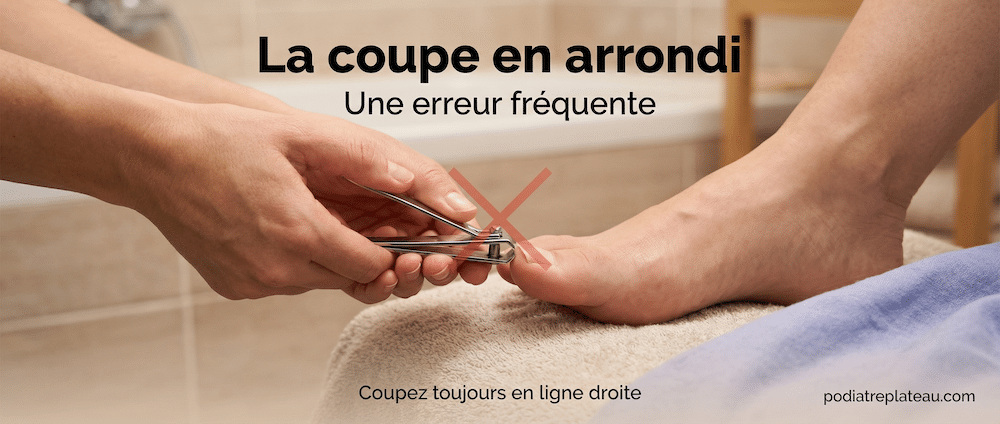
Cutting the corners of the nail in a rounded way is a classic mistake. This gesture, although done with the best intentions, often leaves a small nail tip (a spicule) that then grows directly into the flesh.
Shoes that are too tight
When your toes are compressed, the constant pressure literally pushes the nail towards the surrounding flesh. Shoes with pointed toes are particularly problematic.
Repeated trauma
Running, soccer, tennis, pickleball… These sports, where the foot regularly hits the shoe, can cause micro-traumas that promote embodiment.
When an ingrown toenail comes back more than two or three times, conservative treatments are usually no longer enough. This is where matrixectomy comes in.

Matrixectomy: how does it work?
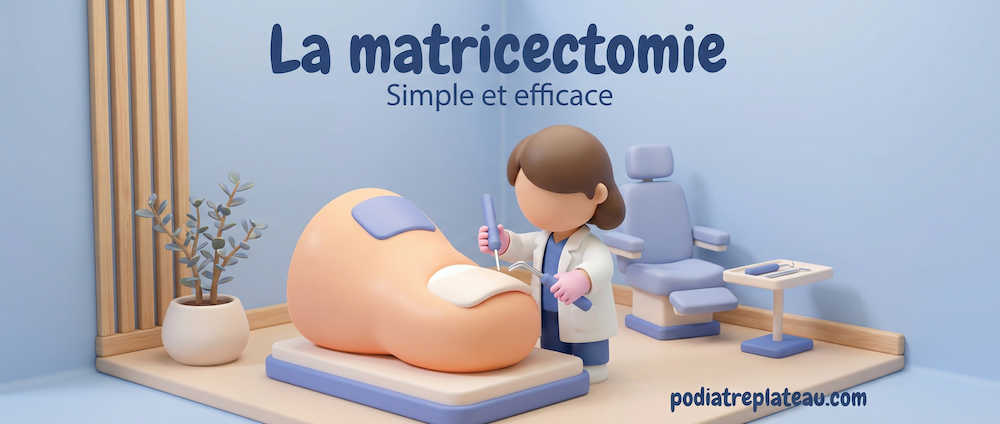
Partial matrixectomy — also called partial onycectomy — is a minor surgical procedure to permanently fix the problem. The idea is simple: remove the problematic portion of the nail AND destroy the matrix (the root) in this precise place to prevent any regrowth of the border that injures the skin.
Here’s how the procedure works:
Local anesthesia
Your podiatrist first completely numbs your toe. You will not feel any pain during the procedure. The injection itself can sting and cause pain, but the anesthesia effect is rapid.
Removing the nail strip
Once the toe is numb, the podiatrist removes a thin strip of a few millimetres from the side of the affected nail. This strip includes all the portion that sinks into the flesh.
The destruction of the matrix
This is the crucial step. The podiatrist applies a chemical agent (usually phenol, trichloroacetic acid, or sodium hydroxide) to the nail root where the strip was removed. This treatment permanently prevents this portion from growing back.
Cleaning and dressing
The site is thoroughly cleaned and then a suitable dressing is applied.
The entire procedure takes about 20 to 30 minutes. You leave on your feet the same day.
Does it hurt?
Let’s be honest: the idea of surgery on a toe is not particularly pleasant. But the reality is much less scary than you might imagine.
During the procedure, you don’t feel anything thanks to the local anesthesia. Some people find the initial injection uncomfortable or even painful, but it only lasts a few seconds.
After the procedure, when the anesthesia wears off (usually after a few hours), you may feel tingling or mild tenderness. Most patients describe the discomfort as quite manageable. Over-the-counter pain relievers are usually enough to relieve temporary discomfort.
💡 Good to know
The most surprising thing for many patients? They feel less pain AFTER surgery than BEFORE. The inflammation caused by chronic ingrown toenails is often more painful than post-operative healing.

Healing: What to expect?
The first few days after the matrixectomy require some precautions. Your podiatrist will give you detailed instructions, but here are the main points:
The first 24 to 48 hours
Keep your foot elevated as much as possible. Avoid walking too much. The dressing should stay in place and dry.
The first week
You will need to change your dressings according to the instructions received, usually by applying an antibiotic ointment. Avoid strenuous physical activity, running, swimming. Open or very wide shoes are recommended.
The following weeks
Complete healing usually takes 2 to 6 weeks, depending on the individual. A follow-up visit allows your podiatrist to make sure that everything is progressing normally.
Most people can return to work the day after the procedure, unless their job requires standing or walking for a long time. In this case, a few days of rest may be preferable.
What is the success rate?
This is probably THE question you are asking yourself. And the answer is reassuring.
A study published in the Annals of Family Medicine evaluated the effectiveness of partial matrixectomy with phenol ablation on 348 procedures. The success rate observed was remarkable, with only one recurrence out of all cases followed for 24 months (https://www.annfammed.org/content/10/6/556).
Modern matrixectomy techniques offer long-lasting results in the vast majority of cases. The risk of recurrence is generally estimated at less than 5% when the procedure is performed by a podiatrist.
🎯 Point of Comparison
The simple removal of the nail without treatment of the matrix (simple avulsion) has a much higher recurrence rate, sometimes up to 70-80%. This is why matrixectomy is considered the gold standard treatment for recurrent or severe ingrown toenails.
Will my nail look normal after?
A legitimate concern. The good news: the aesthetic results are usually very satisfactory.
After a partial matrixectomy, your nail will be slightly narrower than before — by just a few millimeters. For most people, this difference is barely noticeable. The nail maintains a natural and functional appearance.
Scarring rarely leaves visible marks once healing is complete. Your toes can be proudly displayed in your sandals next summer!
When should you consider a matrixectomy?
Ingrown toenail surgery is not always necessary for all ingrown toenails. A mild first episode can often be treated with a simple foot care where the podiatrist gently clears the edge of the nail.
On the other hand, matrixectomy becomes an option to be seriously considered if:
- Your ingrown toenail comes back regularly despite conservative treatments
- Infection is present or recurrent
- Pain significantly affects your quality of life
- You have diabetes and want to avoid complications
- A granuloma has formed around the nail
The decision is always made in collaboration with your podiatrist, after a complete assessment of your condition.

Prevention: prevention is better than cure
Even after a successful matrixectomy, good foot hygiene habits are still important for your other nails. Here are the basic tips:
Trim your nails properly
Always in a straight line, never rounded. Avoid cutting too short. The corners of the nail should extend slightly beyond the skin.
Choose the right shoes
Your toes need room to move freely. Avoid shoes that are too tight, especially in the forefoot.
Keep your feet clean and dry
Moisture promotes skin softening and can contribute to embodiment problems.
Consult quickly
At the first signs of an ingrown toenail (redness, tenderness), don’t wait for the situation to get worse. Early treatment avoids many complications.
Why consult a podiatrist for this procedure?
You may be wondering why not just ask your family doctor or go to a walk-in clinic. Here’s why podiatrists are the best professionals for this procedure.
Podiatrists are doctors of podiatric medicine who are dedicated exclusively to the health of the feet. Matrixctomy is part of their basic training and daily practice. They have the specialized equipment and sterilized instruments necessary to perform this procedure in optimal conditions.
In addition, the podiatrist can assess whether biomechanical factors — such as a deformity of the toes or a posture problem — contribute to your ingrown toenails. If necessary, complementary solutions such as orthotics or toe separators may be recommended.
In addition, this type of intervention to treat ingrown toenails is very rarely offered by other professionals such as general practitioners or specialists.
Make an appointment in Gatineau!
The Médecine podiatrique du Plateau team, located in the urban village of AGORA in Gatineau, offers the complete treatment of ingrown toenails, from simple clearance treatment to a minor surgical procedure (matrixectomy) for recurrent cases.
Drs. Émile Carrier, Sandra Gendron and Stephen Davis, podiatrists, welcome patients for consultations and can perform the matrix directly in the clinic. Emergency appointments are also available for situations that require prompt care.
📞 819-800-1212
📍 20 Hamburg Lane, Entrance A, 2nd floor, Gatineau, Quebec
🌐 https://podiatreplateau.com/nous-joindre/
Results vary according to the state of health of each person. A care plan is drawn up after evaluation.
Frequently asked questions
What exactly is a matrixctomy?
Matrixectomy is a minor surgery that involves removing a portion of the ingrown toenail and destroying the corresponding root (matrix) to prevent that part from growing back. The procedure is done under local anesthesia in the clinic and lasts about 20-30 minutes.
Does ingrown toenail surgery hurt?
The procedure itself is painless thanks to local anesthesia. After the procedure, mild discomfort may be felt for a few days, but it is usually well controlled with over-the-counter pain relievers. Many patients report less pain after surgery than they did with the ingrown toenail.
How long does it take to heal after a matrixctomy?
Complete healing usually takes 2 to 6 weeks. Most people can return to normal activities the next day, but strenuous sports activities are not recommended for about a week.
Will my nail grow back after matrixectomy?
The treated portion will not grow back, this is the goal of the procedure. Your nail will be slightly narrower (by a few millimeters), but will still look natural.
What is the success rate of matrixectomy?
Scientific studies report success rates generally above 95% for partial matrixectomy with chemical treatment of the matrix. The risk of recurrence is low when the procedure is performed by an experienced podiatrist.
Does insurance cover matrixectomy?
Most private insurance covers podiatric services, including matrixectomy. The necessary documentation for your claims will be provided to you. Contact your insurer for details of your coverage.
Can I drive after the procedure?
It is usually best to arrange a companion for the return home, but only the affected toe is anesthetized, so the rest of the foot functions normally. However, local anesthesia can temporarily affect the sensation in your foot.
